

Professional grade lures are specialized fishing tools built to perform under real offshore and tournament conditions, where generic tackle simply fails. The difference between a productive day on the water and a blank one often comes down to lure selection, and the best examples of professional grade lures share three non-negotiable traits: precise depth targeting, a lifelike silhouette, and an action that triggers strikes from educated fish. Captain Troy Wetzel’s proven offshore arsenal covers five distinct lure types that address different depths and bite behaviors for trophy yellowfin tuna. Understanding why these tools work gives you a real edge, whether you’re running tournament spreads or chasing billfish offshore.
1. What are the top examples of professional grade offshore trolling lures?
Professional offshore captains rely on a core set of lure types that have earned their place through consistent results. Each type targets a specific depth zone and mimics a distinct forage profile.
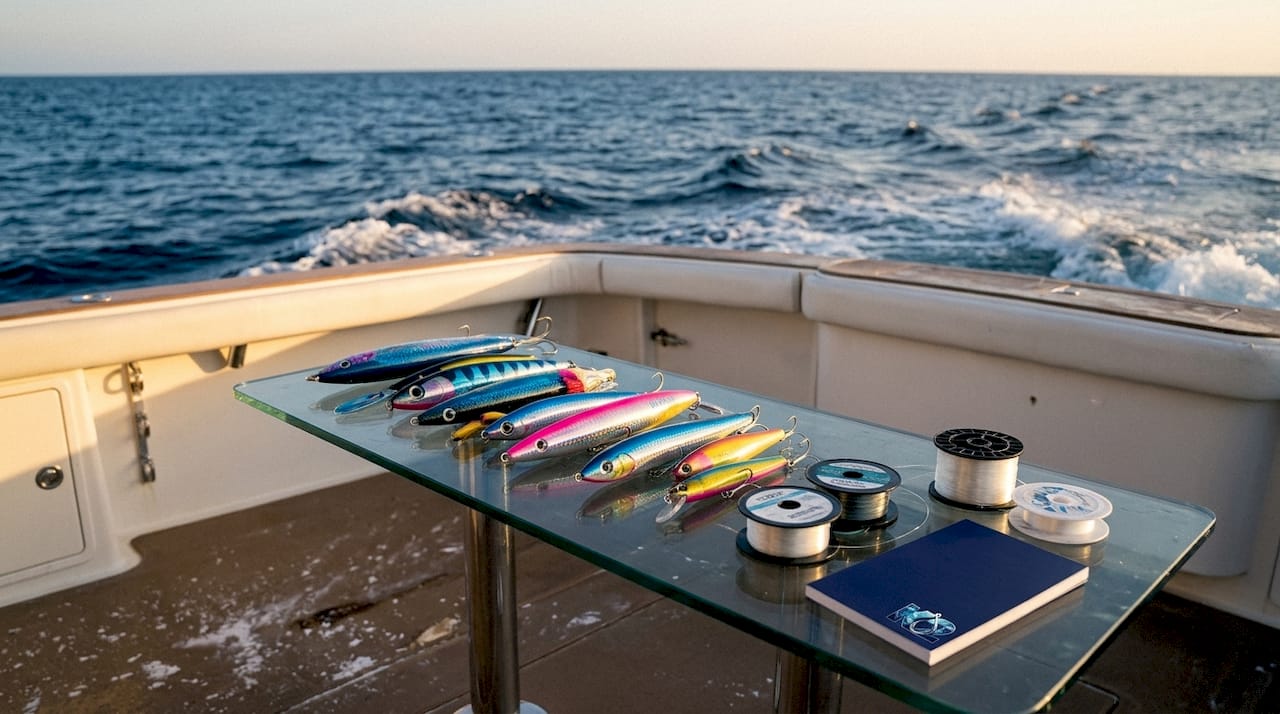
Topwater poppers
Topwater poppers create surface commotion that draws aggressive yellowfin tuna and mahi-mahi up from below. They work best in calm to moderate seas when fish are visibly feeding near the surface. The cupped face displaces water and produces a sound that mimics a struggling baitfish.
- Best conditions: Calm to light chop, visible surface activity
- Target species: Yellowfin tuna, mahi-mahi, wahoo
- Key feature: Cupped face for maximum surface disturbance
Flat-fall jigs
Flat-fall jigs sink in an erratic, side-to-side flutter that imitates a dying baitfish. They are the go-to choice when fish are holding at mid-water column depths and ignoring surface presentations. The action requires minimal rod work, making them accessible for anglers at any experience level.
- Best conditions: Fish holding at 60–200 feet
- Target species: Yellowfin tuna, amberjack, grouper
- Key feature: Erratic flutter on the drop
Pro Tip: Drop a flat-fall jig to the bottom and work it back up in short, sharp lifts. Most strikes happen on the fall, so watch your line for any sudden slack.
Classic trolling lures with ballyhoo
Rigged ballyhoo behind a skirted trolling head is one of the most time-tested setups in offshore fishing. The natural baitfish profile and swimming action produce a presentation that billfish and large tuna find hard to refuse. Trolling lure selection for this style centers on matching head weight and skirt color to sea conditions and target depth.
- Best conditions: Blue water, 3–8 knots trolling speed
- Target species: Blue marlin, white marlin, sailfish, yellowfin tuna
- Key feature: Natural baitfish profile with skirted flash
Flying fish imitations
Flying fish are a primary forage species for billfish across the Atlantic and Pacific. Lures that replicate the elongated body and wing-like pectoral fins of a flying fish trigger instinctive strikes from marlin and sailfish. These lures typically run best at the surface or just below it, creating a skipping action that matches how real flying fish behave when fleeing predators.
- Best conditions: Open blue water, moderate to heavy sea state
- Target species: Blue marlin, sailfish, spearfish
- Key feature: Skipping surface action mimicking fleeing prey
High-speed diving plugs
High-speed plugs run at 10–15 knots and dive to a consistent depth on a straight retrieve. Wahoo are the primary target, as they respond to fast-moving lures that cover water quickly. UV and glow patterns built into quality plugs improve visibility in deep or low-light conditions, triggering aggressive strikes.
- Best conditions: Deep blue water, high-speed trolling passes
- Target species: Wahoo, kingfish, large mahi-mahi
- Key feature: Consistent depth at high trolling speeds
| Lure Type | Depth Zone | Primary Action | Target Species |
|---|---|---|---|
| Topwater popper | Surface | Surface splash | Yellowfin tuna, mahi |
| Flat-fall jig | 60–200 ft | Flutter on drop | Tuna, amberjack |
| Ballyhoo trolling rig | Surface to 30 ft | Swimming baitfish | Marlin, sailfish |
| Flying fish imitation | Surface | Skipping | Blue marlin, sailfish |
| High-speed diving plug | 10–40 ft | Straight dive | Wahoo, kingfish |
2. How professional anglers select tournament lures
Professional lure selection follows a strict four-part hierarchy: depth zone, silhouette, color, and action. Experienced anglers prioritize depth zone first because a lure running at the wrong depth will not encounter fish, regardless of how realistic it looks. Amateurs almost always reverse this order, obsessing over color while ignoring where the fish are actually feeding.
The “match the hatch” concept applies directly to lure profile. A lure’s body shape and size must resemble the prey species fish are actively eating. If yellowfin tuna are feeding on 4-inch sardines, a 10-inch skirted lure will produce far fewer strikes than a smaller, slimmer profile. Fish senses like lateral line detection and vision both respond to profile and movement before color registers.
Color becomes relevant only after depth and profile are correct. Under bright conditions, natural baitfish colors like silver, blue, and white outperform flashy patterns. In low light or stained water, high-contrast colors and UV finishes trigger more strikes.
Action is the final variable. A lure with the right depth, profile, and color but a stiff, unnatural action will still underperform. Professionals test lure action alongside the boat before setting the spread, watching for a natural swimming or skipping motion.
Ranked selection criteria:
- Depth zone (where fish are feeding)
- Silhouette and profile (size and shape matching prey)
- Color (visibility and contrast for conditions)
- Action (movement that triggers a strike)
Pro Tip: When fishing under tournament pressure, lock in depth and profile first. Changing color is fast and easy. Changing your entire lure type mid-tournament costs time and momentum.
3. What lures work best for pressured tournament fish?
Pressured fish are fish that have seen a lot of lures. They become selective and refuse presentations that look even slightly unnatural. Urchin-style and fuzzy baits with subtle, lifelike movements are proven performers in these situations because they do not look like a standard production lure.
The key is retrieve speed and pause. Slow twitch retrieves and dead-still pauses give wary fish time to commit. A fish that follows a fast lure will often turn away. The same fish will strike a lure that stops and sits motionless for two seconds.
Effective lure actions for pressured fish:
- Slow twitch with a 2-second pause
- Dead-still suspension at target depth
- Finesse retrieve with minimal rod movement
- Subtle side-to-side wobble at low speed
- Erratic micro-darting on a slack line
Professional angler Brandon Palaniuk makes the point clearly: confidence and execution matter more than the specific lure brand or price point when fish are pressured. A well-executed presentation with a modest lure beats a sloppy presentation with an expensive one every time.
Lure strategy outweighs lure cost in pressured scenarios. The angler who understands how to work a lure will consistently outfish the angler who simply buys the most expensive option in the tackle shop.
4. How captains use real-time adjustments to maximize lure effectiveness
Lure choice alone does not produce consistent catches. Offshore captains adjust spread distance, trolling speed, and lure patterns continuously based on what the water and fish are telling them. Static lure use is an amateur habit.
The variables captains monitor in real time:
- Bird activity: Diving birds mark baitfish schools and active feeding zones.
- Current lines: Temperature breaks and color changes concentrate bait and predators.
- Satellite temperature charts: Captains identify productive water before leaving the dock.
- Trolling speed: Adjusting speed changes lure depth and action simultaneously.
- Spread distance: Wider spreads cover more water; tighter spreads work better in concentrated bait.
- Lure position in spread: Short rigger, long rigger, flat line, and shotgun positions each present lures differently.
Experienced captains adjust lure presentation dynamically based on observed fish behavior, which consistently increases hookups compared to running a fixed spread all day. This flexibility separates professionals from recreational anglers.
Coordinating with nearby boats adds another layer. Informal networks of 10–12 boats sharing real-time bite information allow captains to identify productive zones faster than any single boat could alone. When one boat reports a bite on a specific lure at a specific depth, the entire network adjusts. That collective intelligence is a genuine professional edge. Tournament rules sometimes limit how captains can share information, so knowing the regulations before competition day matters.
Key Takeaways
Professional grade lures succeed because of depth targeting, profile accuracy, and adaptive presentation, not brand name or price alone.
| Point | Details |
|---|---|
| Depth zone comes first | A lure at the wrong depth will not produce bites regardless of color or action. |
| Profile must match prey | Size and shape resembling local forage triggers more strikes than any other variable. |
| Pressured fish need subtlety | Slow retrieves and dead-still pauses convert wary fish that reject fast presentations. |
| Real-time adjustments win | Captains who adapt trolling speed, spread, and lure type outfish those who run a fixed setup. |
| Boat networks multiply effectiveness | Sharing bite information across 10–12 boats accelerates lure and location adjustments. |
What I’ve learned about trusting lures versus trusting conditions
The biggest mistake I see serious anglers make is falling in love with a specific lure. They run the same setup day after day because it worked once, and they stop reading the water. The best examples of professional grade lures are tools, not talismans.
Captain Troy Wetzel’s tournament-tested approach makes this clear: knowing when and how to deploy a lure matters as much as the lure itself. I’ve watched anglers run a topwater popper in flat, lifeless water for two hours because “it worked last week.” Meanwhile, a flat-fall jig dropped to 150 feet would have been in the fish the whole time.
The mental side matters too. Brandon Palaniuk’s point about confidence and momentum under tournament pressure is something I’ve seen play out repeatedly. Anglers who second-guess their lure choice every 20 minutes never build the focused execution that produces consistent results. Pick your setup based on conditions, commit to it for a reasonable window, and adjust based on evidence, not anxiety.
My honest advice: build a small core of proven lure types that cover different depth zones and forage profiles. Learn each one deeply. Then let the water tell you which one to run. That combination of preparation and adaptability is what actually separates productive anglers from everyone else.
— Daniel
K2fishing handcrafted trolling lures built for serious offshore work
Anglers who want professional grade performance without sorting through mass-produced options have a direct path at K2fishing. Every lure is handcrafted in the USA using abalone resin, a material that produces a natural brightness and flash that factory lures cannot replicate. The result is a trolling lure that checks the boxes professionals care about: correct depth profile, lifelike visual trigger, and the durability to handle repeated offshore use.
The Red Abalone Big Eye Lure is a 7.5-inch trolling lure built specifically for big-game species like marlin, tuna, and wahoo. Seasoned anglers who have fished it report consistent results and give it five-star ratings. For anglers targeting open blue water, the Ghost White Abalone Trolling Lure offers a clean, high-contrast profile that performs in bright conditions. Both lures are rigorously tested in real offshore conditions before reaching the market.
FAQ
What makes a lure “professional grade”?
A professional grade lure is built for specific depth zones, carries a lifelike silhouette, and produces a consistent action under real fishing conditions. Durability and material quality separate these lures from mass-produced options.
Which lures do tournament anglers use most often?
Tournament anglers rely on topwater poppers, flat-fall jigs, rigged ballyhoo trolling setups, flying fish imitations, and high-speed diving plugs, each chosen to match a specific depth zone and target species.
How do professionals select lures for pressured fish?
Professionals prioritize subtle actions like slow twitch retrieves and dead-still pauses. Urchin-style and finesse baits outperform standard production lures when fish have seen heavy pressure.
Does lure color matter more than depth zone?
Depth zone matters more than color. A lure running at the wrong depth will not produce bites regardless of color. Professionals lock in depth and profile before adjusting color.
How do offshore captains adjust lures during a trip?
Captains monitor bird activity, current lines, water temperature, and trolling speed, then adjust spread distance and lure position in real time. Sharing bite information with nearby boats accelerates these adjustments.