

Lure position is defined as the deliberate placement of each lure at a specific distance, depth, and lateral angle behind the boat to trigger feeding strikes from big-game fish. The role of lure position in tournament trolling goes far beyond simply dragging baits behind the hull. Where you place each lure determines whether marlin, tuna, and wahoo see a natural prey presentation or an unnatural disturbance they ignore. Shimano’s 2026 data confirms that metered lines and rod angle adjustments produce steady lure depth and consistent presentation across the spread. Get the placement right, and your spread becomes a feeding zone. Get it wrong, and you are covering water without catching fish.
How does lure position affect fish feeding behavior and strike rates?
Predator fish respond to visual and lateral line cues, not to boat speed alone. A lure running in a clean water lane behind the boat presents a clear silhouette and consistent action that mimics a fleeing baitfish. Place that same lure in the prop wash, and the turbulence breaks up its movement, killing the feeding trigger. Industry experts confirm that lure action must be natural and consistent to trigger strikes. Predator fish are not checking speedometers. They are reacting to what looks alive.
Lateral spread position matters just as much as distance. Lures running in the flat lines, closest to the boat, sit in the most disturbed water. Lures on the long rigger lines run in cleaner, calmer water and often produce more strikes on pressured fish. The spread creates a visual hierarchy that mimics a school of baitfish fleeing in multiple directions.
Key factors that affect strike rates through lure placement:
- Clean water lanes: Lures running outside the prop wash present a cleaner silhouette and more natural action.
- Consistent action: A lure that tracks straight and steady looks alive. One that spins or skips looks wrong.
- Depth presentation: Fish holding at 60 feet will not rise 100 feet to eat a surface lure unless conditions force them up.
- Lateral distance from the boat: Boat-shy fish, common in tournament pressure, respond better to lures set far back on long rigger lines.
Pro Tip: Watch your lures from the tower before you commit to a spread. If any lure is spinning or skipping, reposition it before you reach the fishing grounds. A lure that looks wrong from 30 feet above the water looks wrong to a marlin from 30 feet below it.
What are the optimal lure depth and distance setups for tournament trolling?
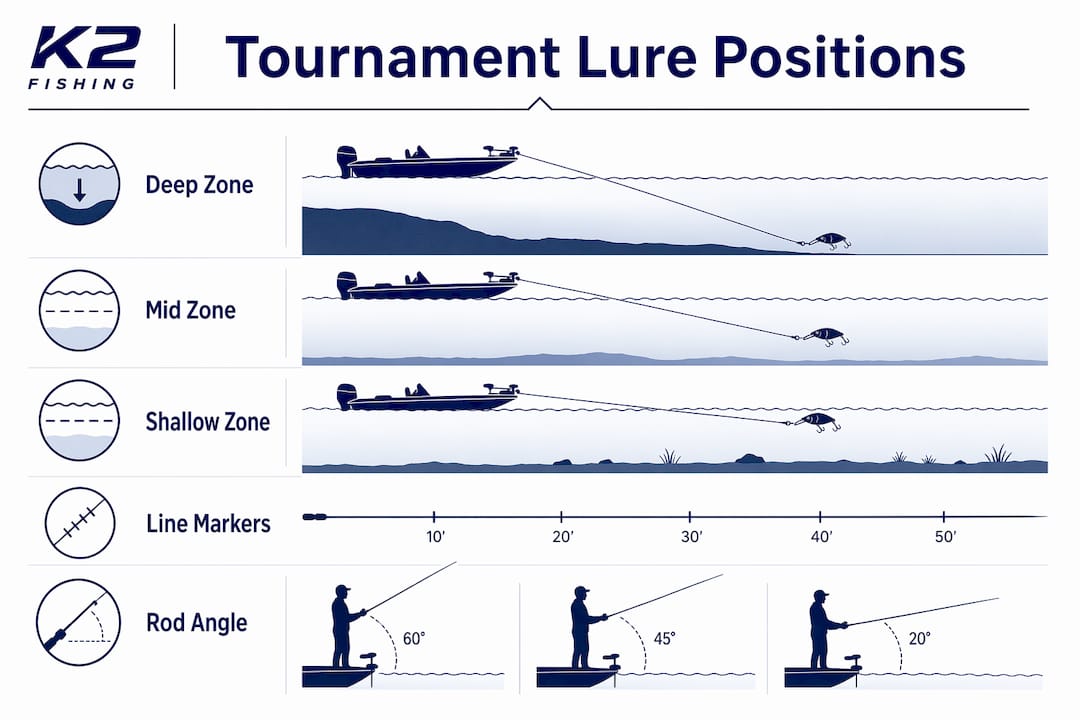
Covering multiple depth zones simultaneously is the single biggest structural advantage a tournament angler can build into a spread. Shimano’s 2026 depth data shows deep-diving plugs placed at 50–75 ft (deep zone), 100–125 ft (mid zone), and 200–300 ft (shallow zone) cover the full water column effectively. That range means fish holding at any depth in the strike zone have a lure in front of them.
The table below shows how to structure a staggered spread by zone:
| Zone | Distance from boat | Depth target | Recommended setup |
|---|---|---|---|
| Deep | 50–75 ft | 20–40 ft | Deep-diving plug, heavy inline sinker |
| Mid | 100–125 ft | 10–20 ft | Medium-diving plug, light sinker |
| Shallow | 200–300 ft | 0–10 ft | Surface or near-surface lure, no sinker |
Inline sinkers placed ahead of the lure maintain depth without killing the lure’s natural action. This is a critical distinction. Adding weight to the leader behind the lure changes the action. Adding an inline sinker ahead of the lure keeps the presentation intact while pulling the lure down to the target depth.
Rod angle also controls depth. A rod tip held high pulls the lure toward the surface. A rod tip angled low and toward the water keeps the lure running deeper. Combining rod angle with metered line lets you place each lure within a few feet of its target depth. This level of control separates anglers who cover water from anglers who cover the right water.
Pro Tip: Mark your line at 50 ft, 100 ft, and 200 ft with different colored markers before a tournament. You will set each lure to its target distance in seconds instead of counting pulls.
How do boat dynamics and trolling speed influence effective lure positioning?
Boat movement is not a passive factor in lure placement. Speed changes, turns, and wake patterns all shift where your lures run and how they behave. High trolling speeds push lures toward the surface and can cause them to skip or spin if they are not designed for that speed range. Shimano’s Ledge Runner maintains straight tracking at speeds up to 15 MPH, which demonstrates how lure design and speed interact directly. A lure that tracks true at 8 knots may blow out at 10 knots.
Turns create a natural spread variation that experienced tournament anglers use deliberately. When the boat turns, the inside lures slow down and drop deeper. The outside lures speed up and rise toward the surface. Turns cause baits to spread unevenly, altering speed and depth in ways that can trigger reactive strikes from fish that ignored the straight-line presentation.
Adjustments to make based on boat dynamics:
- Reduce speed in rough water: Chop and swells push lures off their tracking lines. Slowing down restores natural action.
- Widen the spread in calm water: Flat conditions let you run longer lines without tangling, covering more lateral ground.
- Use turns as a tool: A slow, wide turn lets inside lures drop and outside lures accelerate, creating a brief feeding window.
- Place lower-riding lures on outer rigs: Lower-riding outer lures maintain consistent depth around structure despite boat-induced lure motion, keeping them in the strike zone when the boat moves through current edges or structure.
Structure and current edges add another layer of complexity. When you cross a temperature break or a current edge, the water resistance on your lures changes. Lures that were tracking at 15 feet may suddenly rise to 8 feet. Checking your spread every time you cross a visible water change is not optional in a tournament. It is the difference between a lure in the zone and a lure wasting time.
How to adapt lure position strategies during a tournament based on real-time bite data?
Real-time adaptation is where tournament anglers separate themselves from recreational fishermen. The spread you set at the start of the day is a hypothesis. Every bite is data that either confirms or disproves it. Tournament success hinges on shifting spreads to replicate the distances and depths where consistent strikes occur. When a pattern emerges, you act on it immediately.
A practical adaptation sequence for tournament conditions:
- Track which line produces the first strike. Note the exact distance, depth, and lure type. Write it down. Memory fails during a hot bite.
- Move a second lure to match the productive position. If the long rigger at 200 ft produced the strike, shift a flat line back to 200 ft and compare results.
- Confirm the pattern with a second strike. One bite is a coincidence. Two bites on the same setup is a pattern worth committing to.
- Collapse the spread around the productive zone. Once you know fish are holding at a specific depth and distance, concentrate your lures there rather than covering the full spread.
- Keep one lure in a different zone as a control. If conditions change and the productive zone goes cold, the control lure tells you whether fish have moved up, down, or out.
Flexibility is the core skill here. Anglers who commit to a spread and refuse to change it are fishing yesterday’s conditions. Quick adaptation based on bite patterns maintains optimal strike zones and maximizes hookups throughout the tournament day. The best tournament anglers treat their spread as a living system, not a fixed setup.
The K2fishing offshore lure FAQs cover common spread questions that come up when anglers are building their first tournament setup or refining an existing one.
Key Takeaways
Lure position is the primary variable that determines whether your tournament spread produces bites or produces nothing.
| Point | Details |
|---|---|
| Cover multiple depth zones | Stagger lures at 50–75 ft, 100–125 ft, and 200–300 ft to reach fish at any depth. |
| Use inline sinkers for depth control | Place sinkers ahead of the lure to maintain depth without disrupting natural action. |
| Use boat turns deliberately | Turns create speed and depth variation that can trigger strikes from fish ignoring straight-line presentations. |
| Adapt spread to bite data | Shift lures to match the distance and depth of confirmed strikes rather than holding a fixed spread. |
| Natural lure action drives strikes | Predator fish respond to consistent, lifelike movement, not speed alone. |
What I have learned about lure position after years on the water
Tournament fishing taught me one lesson faster than any other: the angler who watches the spread wins more fish than the angler who watches the sonar. I spent my first few tournaments obsessing over bottom structure and water temperature while my spread ran on autopilot. My catch rate reflected that mistake.
The shift happened when I started treating every bite as a positioning clue. A strike on the short rigger told me fish were holding close to the boat. A strike on the long flat line told me they were boat-shy and running deep. Once I started logging which line produced which bite, patterns emerged within a single tournament day that I could act on in real time.
The most counterintuitive thing I have learned is that a smaller, tighter spread often outperforms a wide one. Conventional wisdom says cover more water. My experience says cover the right water with precision. When I collapsed my spread around a productive depth zone and ran three lures within 20 feet of each other at the same depth, my hookup rate improved noticeably compared to running a wide spread that covered everything loosely.
Lure action consistency is the other factor most anglers undervalue. I have pulled a lure that looked perfect from the cockpit and watched it spin the moment I got a clean angle from the bridge. That lure caught nothing all day. The moment I repositioned it to run true, it produced a strike within 20 minutes. Fish see things we miss from deck level. Get above your spread whenever you can and look at every lure critically before you commit to a long run.
— Daniel
K2fishing lures built for tournament-level spread control
Tournament anglers need lures that hold their action at variable speeds, track true through turns, and produce the flash that triggers strikes in open water. K2fishing handcrafts each lure in the USA using abalone resin, which delivers a brightness and flash that synthetic materials cannot replicate at depth.
The K2fishing trolling lure collection includes options built specifically for the depth zones and speed ranges covered in this article. Whether you are running a tight spread around a productive depth zone or covering the full water column, K2fishing lures maintain the natural action that predator fish respond to. Visit K2fishing to find the right lures for your next tournament spread.
FAQ
What is the role of lure position in tournament trolling?
Lure position determines the depth, distance, and lateral placement of each lure behind the boat to create a spread that triggers feeding strikes. Correct positioning covers multiple depth zones and presents natural lure action to target species like marlin, tuna, and wahoo.
How far back should lures be set for tournament trolling?
Deep-diving plugs perform best when staggered at 50–75 ft, 100–125 ft, and 200–300 ft behind the boat. This range covers the deep, mid, and shallow zones simultaneously, giving fish at any depth a target.
How does trolling speed affect lure placement?
Higher speeds push lures toward the surface and can cause spinning or skipping if the lure is not designed for that speed. Lure action must remain natural and consistent at your target speed, so match your lure selection to your trolling speed before setting the spread.
How do I adjust my spread during a tournament?
Track which line produces strikes, note the exact distance and depth, then shift a second lure to match that position. Two strikes on the same setup confirm a pattern worth concentrating your spread around.
Do inline sinkers affect lure action?
Inline sinkers placed ahead of the lure maintain depth without disrupting the lure’s natural movement. Adding weight to the leader behind the lure changes the action, so always rig sinkers ahead of the lure when depth control is the goal.